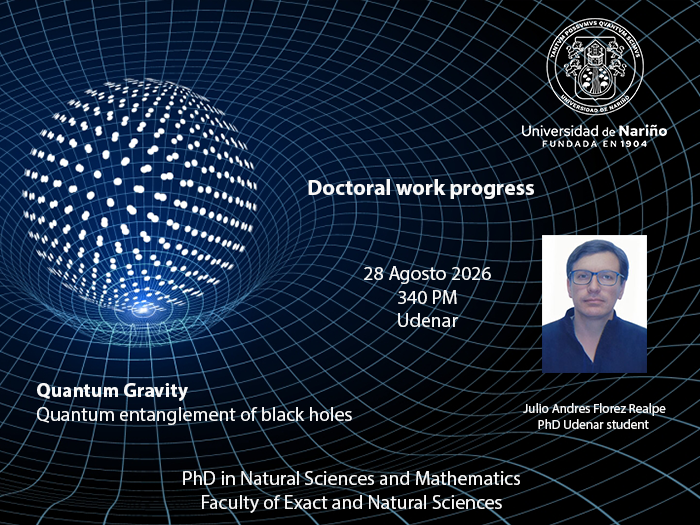
|

MD. PhD
student |
________________________________________________________
Bio
Julio Andres
Florez Realpe
I am a physicist,
physician, and technology entrepreneur
with an interdisciplinary background
dedicated to scientific research,
innovation, and the development of
high-impact technologies. My areas of
interest include medical devices, bionics,
astronomy, computer science, and technology
entrepreneurship, integrating knowledge from
diverse fields to create innovative
solutions for healthcare, science, and
education.
My academic background includes studies in
Physics at the National University of
Colombia, Medicine at the Cooperative
University of Colombia, a Master’s degree in
Physics, a Diploma in Astronomy, and
doctoral studies in Science and Mathematics
at the University of Nariño. I have also
pursued a BA in Piano and Voice at the
University of Nariño, reflecting my
interdisciplinary interest in the
intersection of science, technology, and the
arts
Research
________________________________________________________
Physics
My doctoral research
focuses on Quantum Gravity, Quantum
Entanglement, and Vacuum Energy in
Understanding the Structure of Spacetime.
The project addresses one of the fundamental
challenges of contemporary theoretical
physics: the incompatibility between quantum
mechanics and general relativity in extreme
gravitational environments, particularly
black holes, where the information paradox
reveals a deep conflict between Hawking
radiation and the principle of quantum
unitarity.
This research investigates the
possibility that spacetime geometry emerges
from quantum information structures, with
quantum entanglement acting as a fundamental
mechanism connecting information, energy,
and gravitational dynamics.
Using
theoretical modeling and computational
simulations, the study analyzes entanglement
entropy, quantum correlations, and the
evolution of information in simplified
quantum systems, supported by frameworks
such as quantum gravity, holography, the AdS/CFT
correspondence, the ER=EPR conjecture, and
quantum field theory in curved spacetime.
The aim is to contribute to the
understanding of the microscopic structure
of spacetime, the conservation of
information in black holes, and the role of
vacuum fluctuations in the fundamental
organization of the universe.
Musical Influence on
Brain Electrical Activity
This research studies the influence of
different musical genres on brain electrical
activity through electroencephalography
(EEG) analysis in music students. The study
investigates how musical stimuli modify
alpha, beta, theta, and delta brain waves,
as well as their relationship with cognitive
processes, emotional states, concentration,
and academic performance.
The results show
that music produces measurable neurophysiological changes, with different
genres generating specific patterns of brain
activation and relaxation. This research
explores the role of music as a modulator of
brain activity and its potential
applications in education, cognitive
performance, and well-being.
Neural Modeling of
Brain Dynamics and Epileptic Seizure
Prediction
This research studies the development of a
physical-mathematical neural model to
describe the dynamics of millions of
interconnected neurons and explain the
origin of brain waves observed in
electroencephalography (EEG). The model
allows the estimation of microscopic
neuronal parameters from measurable
macroscopic signals, defining a
patient-specific neural fingerprint that
characterizes brain activity.
Applied to
epileptic patients, the model combined with
artificial intelligence techniques enables
the analysis of EEG patterns, the estimation
of seizure probability, and the potential
prediction of epileptic events before they
occur. This approach provides a framework
for understanding neuronal dynamics and
exploring applications in the diagnosis,
monitoring, and treatment of neurological
disorders such as epilepsy, Alzheimer’s
disease, Parkinson’s disease, schizophrenia,
and depression. |
|